Harry Potter has become a beloved book series and an iconic movie franchise. The world that J.K. Rowling created captured the hearts of an entire generation and her stories were lovingly adapted to the big screen in a pretty great run of eight films in ten years. Of these eight films, everyone has his or her favourite. It may be tied to which book they love best, which one conjures the strongest feelings of nostalgia, or which one most heavily features their favourite character. But there’s one movie which is the most polar. It’s loved and studied by some while being downright hated by others. But I’m here today on the 15th anniversary of the release of Harry Potter and the Prisoner of Azkaban, to make the case that the third film is unequivocally the best of the bunch.

Harry Potter and the Prisoner of Azkaban is perhaps the most important film in the Harry Potter movie franchise for reasons relating to what was going on behind the scenes. The first two films were adoring, faithful adaptations of Rowling’s first two books spearheaded by director Chris Columbus. He laid the foundation on which the entire franchise was built, and crucially put together the core cast that would remain (mostly) intact throughout its entire run. But after shooting Sorcerer’s Stone and Chamber of Secrets back to back, Columbus stepped away from the director’s chair to spend time with his family, and thus handed over directing duties to Alfonso Cuarón.
At this point, the producers of the film franchise could have gone one of two ways. They could have forced Cuarón to mimic Columbus’ style and essentially keep things the same. Or they could have given the Y Tu Mama Tambien filmmaker and eventual two-time Best Director Oscar winner the freedom to play around with the form and put his own stamp on the franchise. Luckily, they chose the latter route.
Beginning with Azkaban, Rowling’s books start becoming much longer and far denser. While it was relatively “easy” to adapt Sorcerer’s Stone and Chamber of Secrets for the big screen without leaving out any major plot points, that task became more difficult as time wore on. So Cuarón and screenwriter Steve Kloves made the brilliant decision to hone the focus of Azkaban on Harry Potter. If a story or subplot didn’t directly affect Harry, it would fall by the wayside. This would become the North Star for the adaptations moving forward, and it’s a big reason why the Harry Potter film franchise was able to succeed without tripping over itself trying to cut down or fit in every single thing from the books (even though the David Yates’ films lacked a bit of precision).
So by significantly altering the adaptation approach with Prisoner of Azkaban, Cuarón put the franchise on a course that would ensure success all the way up through the end. But the second key addition Cuarón made that positions Prisoner of Azkaban as one of the most important Potter movies was altering the aesthetic approach. Columbus’ visual style in the first two films was fairly classic, with bright lighting and a traditional coverage style (though he was also constrained by the inexperience of the young actors). With Prisoner of Azkaban, Cuarón mixed things up significantly, working with cinematographer Michael Seresin to bring in a darker palette and more ambitious camera moves that served to underline the key thematic throughline of the story: change. This eagerness to switch up the visual approach without betraying what came before would become a mainstay of the franchise, as directors Mike Newell and David Yates would subsequently come in and feel the freedom to mix things up thanks to Cuarón’s handiwork on Azkaban.†

It is impossible to squeeze all the elements of Rowling’s long novel into the limited running time of a feature film, losing odds and ends along the way. Cuarón never explains, for example, who Padfoot, Prongs, Wormtail, and Moony are, or why Harry sees a spectral stag across the lake as the Dementors swoop in for the kill. A brief history of the Marauders and explanation of the Patronus charm was needed from storytelling point of view. I was not always a huge fan of this film, and this was the very reason. Only after watching it a number of times did I realize what a technical brilliance this film is.
Other omissions are more welcome–specifically a dramatic reduction in the screen time devoted to Quidditch and the decision to skip the self-congratulatory end-of-the-year ceremony featured in each of the first three novels.
Cuarón does not limit his alterations to cutting, however. Rather than treat his source material (the previous films as well as the novel) as received texts, sacrosanct and untouchable, Cuarón freely adds his own flourishes. Hogwarts now features a delicate gothic footbridge and a massive clock tower whose pendulum swings menacingly across the school’s entryway–this latter hinting at the solution to the novel’s central dilemma. The changes of the seasons are dramatized with brief comic set pieces featuring a murderous bit of foliage known as the Whomping Willow. I read an excellent response to this debate, which went something like, “Cuarón didn’t just make an adaptation, he made a film.”
In fact, Cuaron created an entire new topography for Hogwarts grounds. Prisoner of Azkaban is the first in which we really got a sense of just how big the Hogwarts grounds really were. Famous for films such as Children of Men, Gravity, and Roma, Cuarón brought a cinematic style to the film series that hadn’t been explored in the previous films.

Cuarón has made some incredible films that feature his signature “long take”, a prolonged, uninterrupted shot. He has used this technique in many of his films, from Y Tu Mamá También to his latest film Roma. Unlike in Children of Men, the long takes in Prisoner of Azkaban are not used primarily for action scenes. The first and lengthiest of the long takes comes in the Leaky Cauldron inn when Harry encounters the Weasley family and Mr. Weasley takes him aside to warn him about Sirius Black’s escape from Azkaban prison. It lasts for one minute and 53 seconds. The setting is bustling, and the camera movement serves in part to gradually pull attention away from the crowded dining room and to focus on the conversation. The shot opens on the busy table, with a large tea kettle floating on its own through the air. Mrs. Weasley greets Harry, and Mr. Weasley asks to have a word with the boy. They move toward a squared-off opening near the back of the set. A wanted poster for Black, visible to the right of centre from the opening of the shot, becomes more prominent at the frame edge. The camera tracks past the poster through a second opening closer to the camera and stops once the characters are centred. Mr. Weasley tells Harry about Black, and the camera moves back to accommodate them when they come forward to look at the poster. As they continue to talk, the camera again moves backwards as Mr. Weasley steers Harry to a third opening into the main dining room. They pause beside a second poster of Black, and Mr. Weasley explains that Black had betrayed Harry’s parents to Voldemort, who had killed them and tried to kill him. As a man in a bowler sits at the table near them, Mr. Weasley again guides Harry into a more private area. He says Black is going to try and kill Harry and urges Harry not to go looking for him. The shot ends on a push in toward Harry, who replies, “Mr. Weasley, why would I go looking for someone who wants to kill me?” and the scene ends.
This moment marks a crucial change in the narrative tone. The film started with two comic scenes: Harry’s use of magic to inflate his obnoxious Aunt Marge into a human blimp and then the antics of the fantastical Knight Bus that rescues Harry and transports him to the Leaky Cauldron. Now for the first time, the theme of grave danger is introduced, with the insane-looking Black screaming silently in the wanted poster. A darker storyline takes over, though there are many moments of humour to come.
One of the best scenes in Harry Potter and the Prisoner of Azkaban, and perhaps one of the most pivotal to the film’s thematic rhetoric and visual extrapolation and foreshadowing, is an early sequence during Defense Against the Dark Arts where new professor Remus Lupin (David Thewlis) teaches the kids about a creature named a Boggart. It’s an utterly simple scene, very straightforward in its intentions, and it’s not as if the series hasn’t had other classroom-bound scenes that are meant to teach the characters and audience of some plot device that will come in handy down the road. But what distinguishes this scene, for starters, is that we aren’t so much introduced to any piece of information that Harry and company will use later (save for an important visual involving a full moon… but only Hermione is clever enough to decide what it’s significance is) but more that we are thrust into a thematic debate concerning the fine line between what terrifies us and what makes us laugh. And we see just how far Harry has to go in conquering his own fears. Cuarón’s entire film is made up of this debate, balancing fear and joy constantly, but it’s in this scene where we see that macro debate shrunk down to a microcosm. Laughter stems from a deep sense of joy, which is the complete antithesis of fear. During the course of Prisoner of Azkaban, Harry, who genuinely has very little to be joyful about given the way his life has gone up until this point, learns the importance of finding that emotion in the little things. He first confronts his fears as a child, then matures throughout the entire film thanks to mentors and friends, and only vanquishes what scares him the most in the end because he finds joy. Visually, Cuarón is also doing something remarkable with this scene. The film has many motifs, chief among them being doubles and mirrors, both of which are explored in this segment. The scene itself opens up on a tracking shot that seems to take us right into a mirror, bringing us into the scene with a very clever visual trick.
Another aspect where this film excels is the introduction of the new characters and the actors portraying them. Michael Gambon taking over the role of Professor Dumbledore from the late Richard Harris, plays a more mischievous, knowing headmaster, one supportive of Harry, yet not obviously so. Gambon gives just one of the film’s impressive performances. There’s also Emma Thompson’s Divination professor Sybil Trelawney, whose shaky mannerisms, frizzy hair, and magnifying-glass spectacles are a delight in her brief scenes. More than any other, Oldman and Thewlis wholly commit to their roles. Oldman is an actor of uncommon intensity onscreen, and his portrayal of the titular character, the tormented Sirus Black has enough emotion to carry this film; whereas Thewlis brings his own brand of nonchalant confidence to the tortured Professor Lupin, a character, who from his first scenes with Harry, is simply lovable in a broken way. Both actors elevate this material by applying an appropriate density to their characters.

Ah, music,” he said, wiping his eyes. “A magic beyond all we do here!”
Dumbledore’s quote is very fitting when talking about the PoA film.
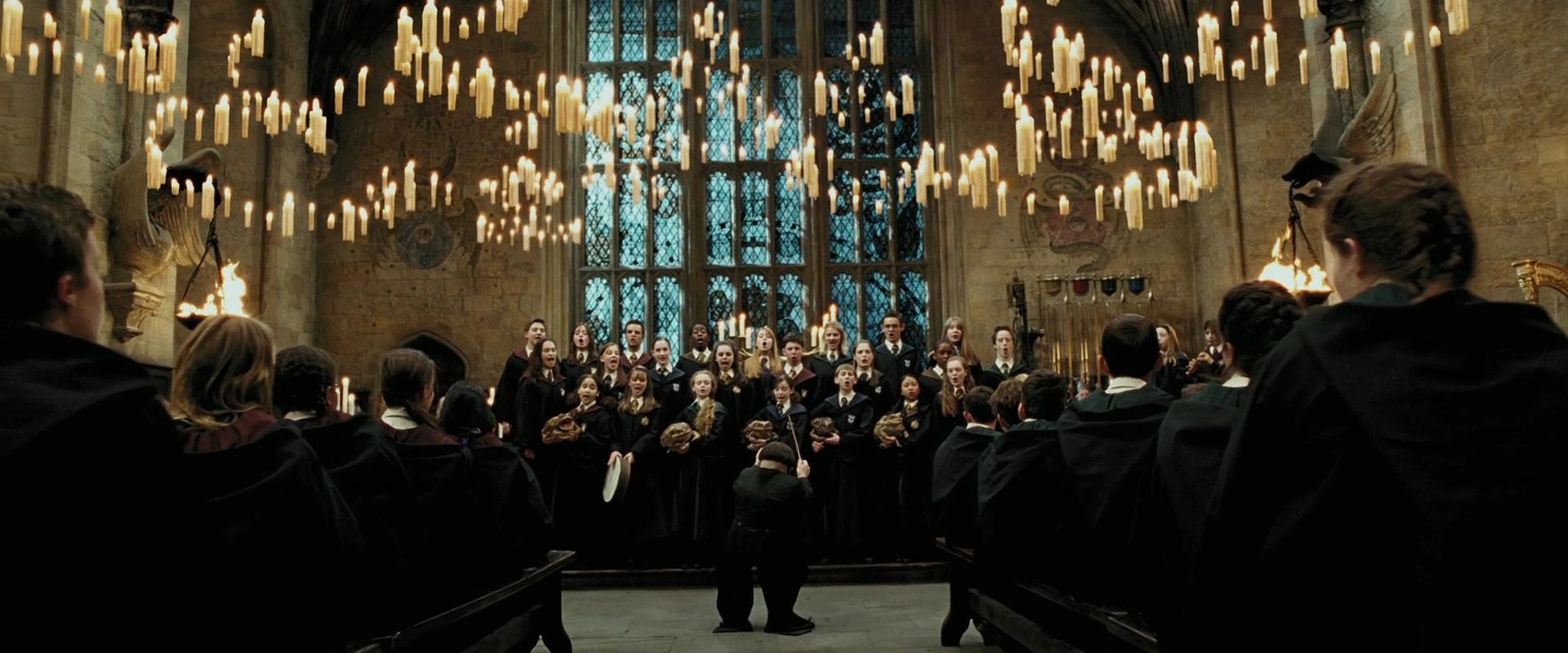
John Williams creates magic with his franchise-best score in this movie. This was the first film that successfully integrated choir music into the wizarding world. The transition between Harry looking out of the train window and the frog choir singing in the Great Hall is one of my favourite moments of the film.
Indeed, the ways in which Harry Potter and the Prisoner of Azkaban is a joyful and satisfying viewing experience are innumerable. Thanks to Cuarón’s confident handle behind the camera, each of these potion ingredients work so well, the final outcome is as wonderful as Felix Felicis. And that’s not to say the other Potter movies don’t also have great moments and interesting direction. But Harry Potter and the Prisoner of Azkaban goes above and beyond, and is artful and entertaining in such fascinating, unique ways, that it becomes the dazzling and radiant diamond pendant in the classic and lustrous gold necklace, the Harry Potter franchise.
I’ll borrow Lupin’s final words in the film to bid goodbye:
“Well — good-bye, Harry,” he said, smiling. ” …I feel sure we’ll meet again sometime.”
Mischief Managed.


 The Film Reel