
“Vikram lander’s descent was as planned and normal performance was observed up to an altitude of 2.1 km. Subsequently, the communication from the lander to the ground station was lost. The data is being analyzed”
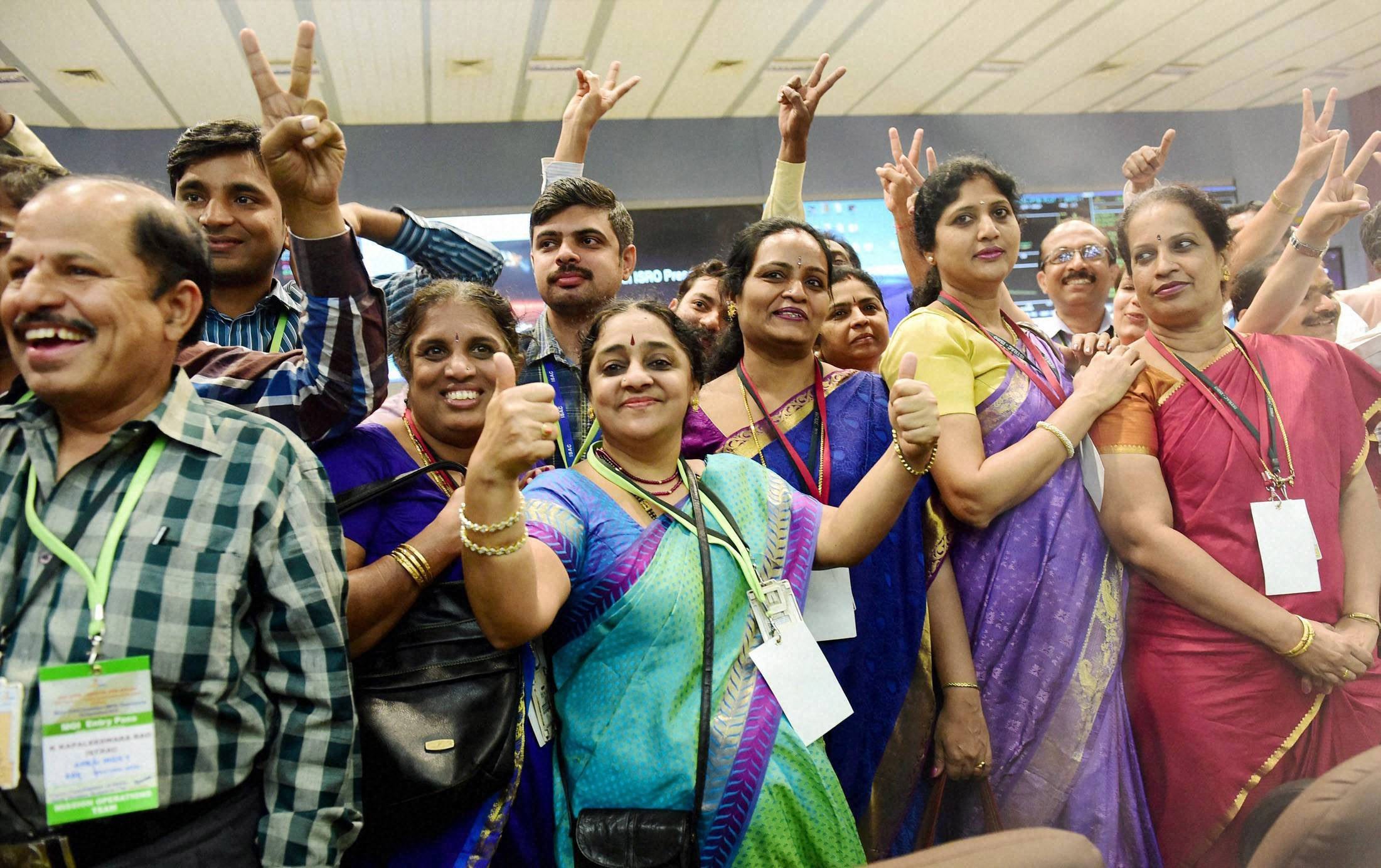
These were the words of ISRO chief K. Sivan at around 2.16 am to a room full of crestfallen scientists at the centre in Bengaluru.
The wildly successful Chandrayaan-1 mission finished most of its major objectives in 2009 despite losing communications with Earth after less than a year in space, about halfway through its planned run. But in that short time, the spacecraft deployed a moon impactor, producing debris that helped prove that there is indeed water on the moon. That sparked a rush for future missions to make use of that precious resource.
On Friday (September 6, 2019), its successor mission, Chandrayaan-2, lost contact with its Vikram lander near the end of the always-hazardous landing process. The Indian Space Research Organisation (ISRO), which runs the Chandrayaan-2 mission, has not yet provided more details about what happened during the landing or what may have caused the anomaly.
India’s space program may have hit a major stumbling block on the road to the moon, but the country has already made major strides in lunar and Mars exploration. India’s next lunar mission, if approved, will be even more ambitious than Chandrayaan-2. The country is in talks with Japan to team up on sending a longer-lived rover to the moon’s south pole in 2023, just one year before NASA hopes to send a human mission to the same region. India and Japan’s rover would explore the frozen water that likely exists in sheltered craters, lying in shadows where the sun’s rays cannot melt it.
In November 2013, the much-awaited Mangalyaan, India’s first interplanetary mission was launched. Less than a year later, the light-weight satellite carrying five crucial instruments, successfully entered the orbit of Mars, the red planet. And history was made. India became the first country to do this on its first try, at a fraction of the cost of what space pioneers— US, Russia, and China– had spent. The Red Planet is a notoriously tough destination, with many missions failing due to technical problems (most recently, the European-Russian Schiaparelli mission of 2016 that attempted to land on Mars). India now hopes to build on its Mars success with a new mission, naturally called Mars Orbiter Mission 2, or Mangalyaan 2.

Mangalyaan was a national triumph, coasting on the amazing innovative spirit of the scientists at ISRO, which influenced a budding director Jagan Shakti to make a film on it.
After being the assistant director of films like English Vinglish, Akira and Paa, this was his first film as a director and it’s not easy for a first-time director to mount a film based on Mars Orbiter Mission, arguably Indian Space Research Organisation’s (ISRO) most ambitious project to date.

Mission Mangal opens with a failed rocket launch and the subsequent exile of Rakesh Dhawan (Kumar), the scientist responsible for India’s efforts to reach Mars. No one expects these efforts to amount to anything, and yet, somehow, thanks to his colleague and second-in-command Tara Shinde’s (Vidya Balan) genius, they come up with a solution that might actually give India a shot at winning the international Mars race. No country has reached Mars’s orbit in its maiden attempt, but India might.

Vidya Balan is wonderful as Tara Shinde, a scientist who must juggle her research with wifely and motherly duties. She is the real fulcrum of the film, and in places, she manages to fly the flag all by herself. Kumar is typically solid as he encourages these ladies to shine (he clearly wants this to be his Chak De India).
There were a couple of moments where Vidya Balan proves again how great and natural actor she is. As Tara reminds her colleagues what inspired them to become scientists in the first place (Star Wars being hers), she not only folds the movie into and tucks it into her pocket, but also makes you reaffirm about the effort that goes in to become a space scientist or an astronaut.

“There is a greater power” – Tara Shinde (Vidya Balan) tells this to her teenage son Dilip, who is heavily influenced by A R Rahman in Mission Mangal. He thinks converting to Islam will make him a sensation just like his guru. This is what she tells her who he tells her why is she praying even if she’s a scientist. She, being the wise and open-minded mother, advises his son to believe and pray to that power, irrespective of any religion or any particular God. This line, for me, was the most significant in the entire movie. But this stirred some “nationalist” echoes around the nation (on Twitter, of course, which has become the first step for making a protest official nowadays). Someone called Akshay Kumar an Islamist proselytizer, and that Hindus are depicted negatively in the movie. The tweet acted like a magnet and the hashtag #BoycottMissionMangal went viral within seconds. However, the film does nothing of that sort and I hope we, as a nation, broaden our approach real soon.
Another factor that works in this film’s favour is its superb timing of the release. Just as you are feeling patriotic on India’s Independence Day, here comes a science film that celebrates the scientific feat of India, which is the most cost-effective mission to Mars ever.
Even so, it requires a heart brimming with national pride to be able to overlook its glaringly problematic parts.
Films about science have to simplify the subject — films about rocket-science doubly so — but here things are brought down to a regretfully basic level. So while there are times Mission Mangal plays out as a pleasant enough entertainer with a message, complete with a caricaturish villain (Dalip Tahil with an unholy accent) there are other times everything feels like too much of a stretch.
There is an attempt at simplifying the science behind the probe with the help of cricket metaphors, but most of them don’t land. What the movie does succeed at is capturing the magnitude of the achievement, and filling the viewer with a sense of wonderment. Isro did, after all, launch the Mangalyaan on a shoestring budget – only 11 percent of what Nasa spent on its Maven orbiter.
Mission Mangal is the fictionalised account of India’s successful mission of sending their satellite to Mars by ISRO scientists and technicians. The Mars Orbitor Mission (MOM) may have taken painstaking research, but director Shakti simplifies it brutally. All those home-science theories of how to make the perfect poori on a gas stove, while saving fuel, being applied to a space mission feels over-simplified. It makes you ask whether collective passion, drive, ambition, and good-heartedness are enough to translate into successful space operations?
While the answer may evade us, the back stories of the women scientists in this film are largely interesting. With Akshay as the brightest moon around which these satellites revolve, the film sets about giving each of the team a backstory. Here’s where Mission Mangal scores, but also sets a trap for itself. There’s no doubt that the actresses do their bits to perfection.

The problem that I was talking about lies in the process of how these women were characterized. The actresses are given ‘types’ rather than characters. There’s the licentious one, the clumsy one, the pregnant one… It’s all a bit ‘Four More Shots Please: Science Edition.’ The problem with creating ‘types’ as underdogs — especially in a film that will largely be mistaken for real-life — is that while asking audiences not to judge these female characters, ironically enough the filmmakers have created them (and their quirks) by judging them.
And going back on the subject of appropriation, the most predictable one I suppose is the erasure of former Prime Minister Manmohan Singh in Mission Mangal. Singh was PM when Mangalyaan was announced and when the satellite was launched into space. India’s present PM was in his chair for just a few months when the satellite entered Mars’ orbit. Yet, Singh gets zero mention in Mission Mangal while Narendra Modi gets a generous amount of beautifully mounted footage.
This film, under the creative direction of R. Balki, had a promising premise to be great one. But somehow it could not make us believe that it was very much possible for Mangalyaan to be a failed mission, had even one small thing gone wrong. First Man might be one of the best examples for creating a truly suspenseful narration about a successful space mission. That said, the closing days before Mangalyaan enters Mars’ orbit are handled well in Mission Mangal. Jagan Shakti is firmly in control of that portion, aided by Chandan Arora’s polished editing. This made the last 15 minutes of the film to be thrilling, but yet all of it seemed too easy.
It is impossible not to enjoy a movie like Mission Mangal, given the subject matter it deals with, combined with Ravi Verman’s softly lit cinematography and elevated by Amit Trivedi’s upbeat music. The women of ISRO are rich material for cinema. So are all women professionals from conservative societies who juggle a daily domestic grind with busy, unconventional careers. Mission Mangal can be lauded for bringing some of them to the big screen, and Vidya Balan for her flawless portrayal of one such woman. One only wishes the makers had dialled down the theatrics and allowed the audience to feel the authenticity and complexity of the operation.

 The Film Reel