
What springs to your mind when you hear about The Shining? Is it the river of blood flowing through the Overlook Hotel? Or the sinister Grady Twins tormenting poor Danny Torrance? Or maybe it’s Jack Nicholson crashing an axe through the bathroom door and shouting “Here’s Johnny!”?
Stanley Kubrick’s 1980 horror strikes a chord with different viewers in different ways, mainly because it’s just so jam-packed with unforgettable screen moments. That’s a big reason why The Shining has become a legit masterpiece – we keep coming back to it again and again, revisiting these iconic sequences and finding new things to love each time.
Based on Stephen King’s same-titled 1977 novel, The Shining (1980) was directed and produced by Stanley Kubrick, who also co-wrote the film’s script with novelist Diane Johnson. Like all of his films, it is a layered, enigmatic work whose true meaning has been hotly debated since its release.

The plot unfolds as a writer and his family agree to spend the winter as caretakers of the Overlook Hotel. Jack Torrance (Jack Nicholson) has taken the position so he can work on his next book. His wife Wendy (Shelley Duvall) and son Danny (Danny Lloyd) spend their days exploring the place. Snowbound in a picturesque landscape, and settled in a beautiful and empty hotel in the off-season, they spend the months together in solitude, connected to the outside world only by radio, and rapidly descend into a nightmare of insanity, supernatural evil and murder.
The Perfectionist Kubrick
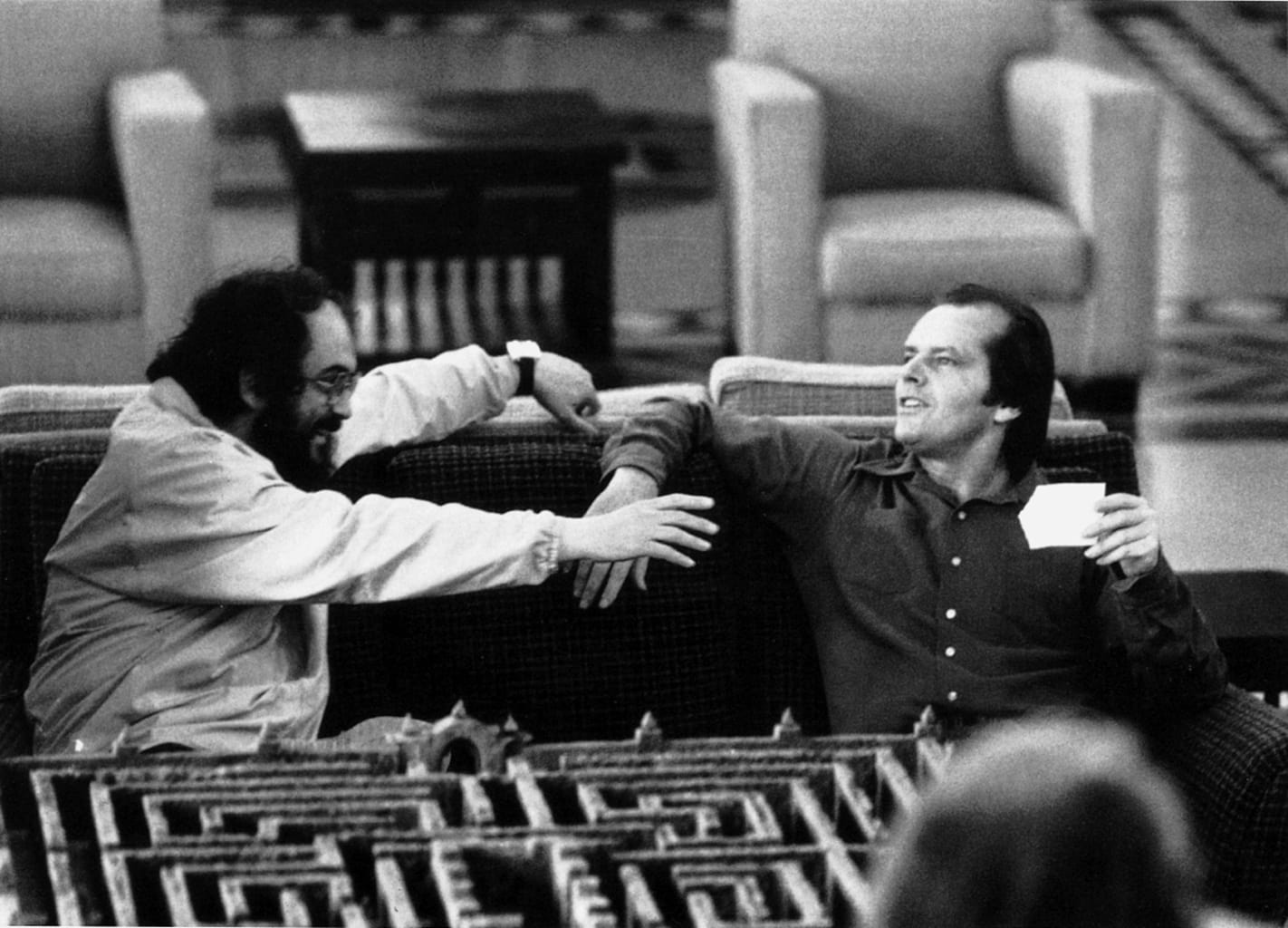
One of the world’s greatest cinematic artists was Stanley Kubrick. He is frequently cited as one of the most influential filmmakers in the history of films. After the disappointing box office failure of Barry Lyndon, Stanley Kubrick set his sights on a commercial property. He chose the proven genre of “horror” (though he rejected both Exorcist and Exorcist II: The Heretic) and when he came across the manuscript of Stephen King’s novel, The Shining, he found the kernel to spark his imagination.
Putting together any film is a monumental challenge, but Kubrick’s perfectionism meant that The Shining took over a year to film, with the gargantuan Overlook Hotel sets taking over the entirety of the UK’s Elstree Studios.
His insistence on dozens of takes drove the actors to the limits of their patience and endurance. He fed Nicholson only cheese sandwiches on set for two weeks (which he hated!) and, according to Shelley Duvall, spending three days (and 60 doors!) getting the “here’s Johnny” scene just right. The 70-year-old Scatman Crothers was made to do a record 148 takes of a single shot, prompting him to query: “What do you want, Mr. Kubrick?”
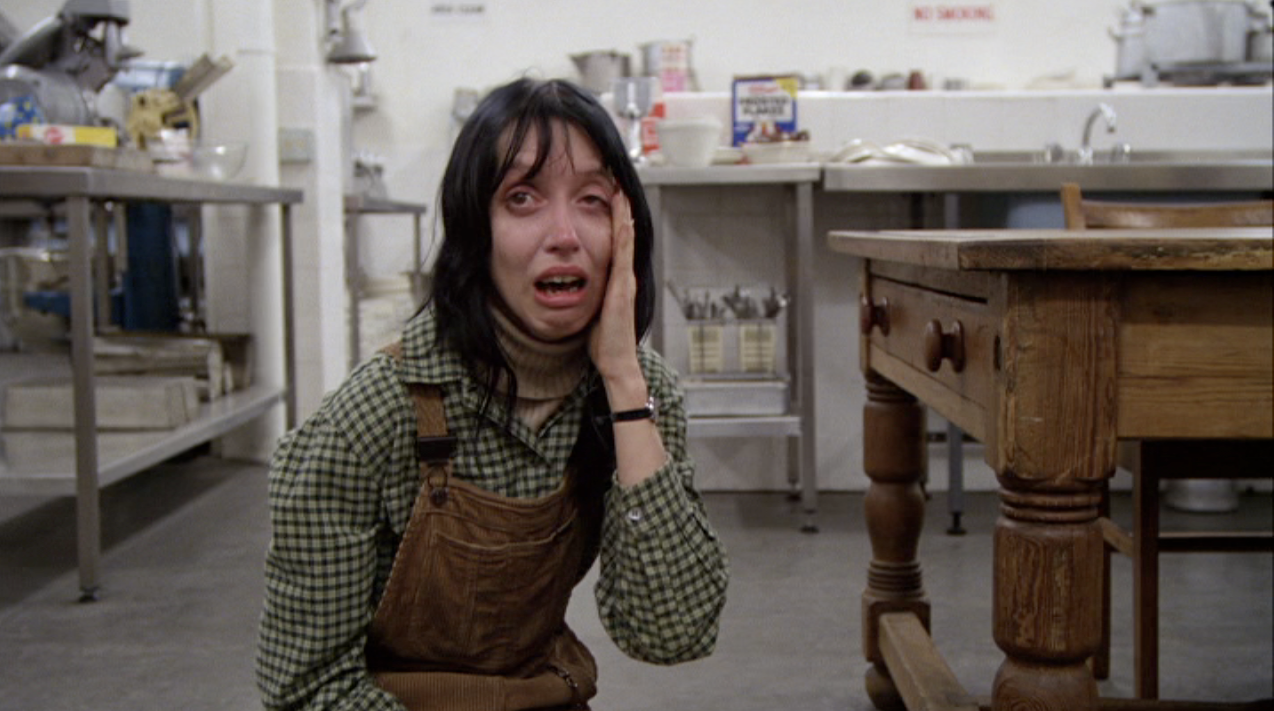
According to editor Gordon Stainforth, those endless pages reading “All work and no play makes Jack a dull boy” were all painstakingly typed up by the production secretary and several assistants. The attention to detail didn’t end there. For foreign language versions of the film, Kubrick refused to just translate that phrase with subtitles. Instead, he came up with different sentennces to put on the reams of paper. So if you watched The Shining in Italy, you’d have been confronted with “Il mattino ha l’oro in bocca”. Translation? “The morning has gold in its mouth.”
Photographing The Shining
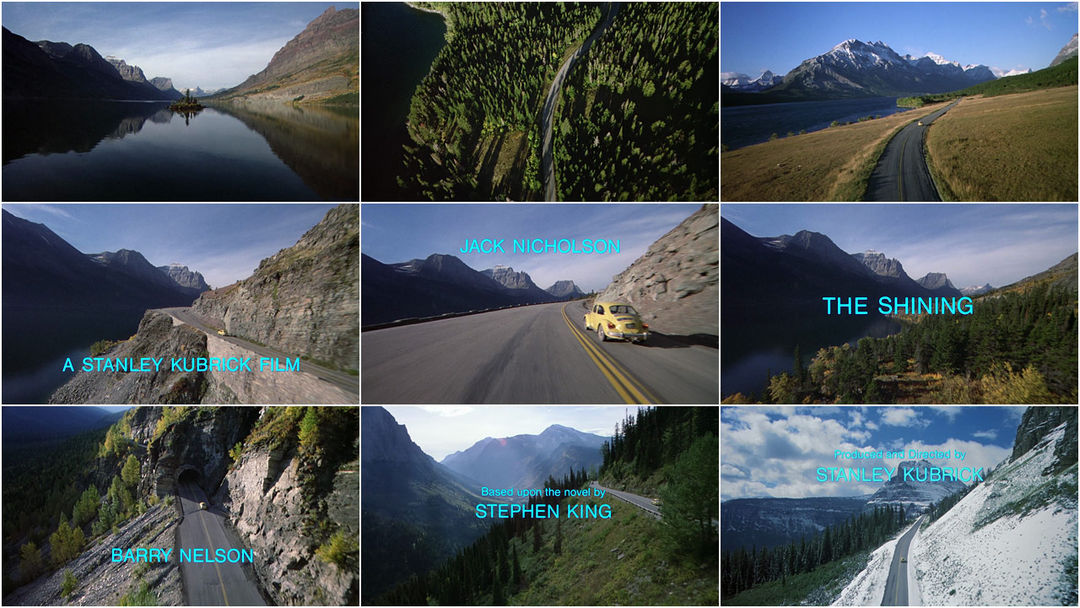
From these opening aerial shots of Montana’s Glacier National Park (outtakes of which were used in Ridley Scott’s Blade Runner) to one of the first uses of the Steadicam to follow young Danny (portrayed by Danny Lloyd) riding through the hotel’s hallways, the cinematography of John Alcott is an integral part of what makes The Shining such an iconic film.

There is one shot in The Shining that stands out for two reasons. One, the composition is perfect in revealing the inner workings of the character it’s focused on, and two, it was conceived and executed in a matter of hours. It is the low angle of Jack Torrance locked in the Overlook Hotel dry goods pantry talking to his wife Wendy after she knocked him out with a baseball bat and locked him inside. Jack starts out trying to manipulate his distraught wife, then in a flash becomes maniacal and crazed with demonic childlike glee when he tells her that he has disabled the Snowcat, Wendy and their young son Danny’s only way to escape the haunted hotel.
Kubrick began to block the scene as he always does with his director’s finder. Now, the fact that he blocked the scene with Jack Nicholson is something only Stanley Kubrick could get away with. No star would stand around and wait while the director comes up with the shot, that’s what stand-ins are for. But Kubrick was Kubrick and Jack knew this. Within a matter of minutes, Kubrick sparked to the idea of laying down on the floor of the pantry looking up to Jack as he leans on the door taunting his wife.


At first, Nicholson played the scene looking straight ahead. Then Kubrick suggested, “could you play it looking down as you say the lines?” Jack did, and Kubrick began to smile like a child as he looked through the finder. He found the perfect shot for the scene.

“I think that, as time goes on, Stanley becomes more thorough, more exacting in his demands. I think that one has to go away after having done a film with him, gather knowledge, come back and try to put that knowledge together with his knowledge into another film. He is, as I’ve said before, very demanding. He demands perfection, but he will give you all the help you need if he thinks that whatever you want to do will accomplish the desired result. He will give you full power to do it — but, at the same time, it must work. Stanley is a great inspiration. He does inspire you. He’s a director with a great visual eye.”
– Cinematographer John Alcott on working with Stanley Kubrick on The Shining, which marked his fourth feature with the director.
The River of Blood
The blood elevator scene, sometimes called the ‘river of blood’ is one of the most horrifying and disturbing images in cinema history. It’s an image that has haunted the nightmares of many filmgoers and was so impressive that the studio focused the film’s marketing almost exclusively around the shot.
The scene itself only lasts twenty-six seconds. Danny, a young boy, stares in a mirror and has a vision. We see a static shot of a lobby facing a set of ornate elevator doors. Blood begins to pour from the edge of one of the doors filling the room in slow motion. There are three quick cuts: the first to a pair of creepy twin girls, the other two to a close-up of Danny’s face shaking in terror. The music is a drone that raises in intensity in short bursts. As the room fills with blood it splashes against the walls till eventually, it covers the camera leaving us in total darkness. It is surreal and symbolic of the horror that will slowly envelop the story.
“We spent weeks and weeks and weeks trying to get the quality of the blood as natural as it could be. The consistency was also quite important because we were pouring out hundreds of gallons of the stuff. And then, of course, there were the mechanics of it, because if you have that much pressure inside something like an elevator, it’s going to blow if you’re not careful … I tell you, it worked in a way we never thought it would work… It was such a violent volume of this red liquid coming at you; those of us who were in there thought, ‘My God—we’re doing to drown!'”
Kubrick’s longtime assistant, Leon Vitali on the making of the iconic scene
The Sound of Fear
Kubrick changed the game in Hollywood when he started to use existing pieces of music for his films, rather than commissioning original scores. In The Shining, he makes exemplary use of both the music of Ligeti, as well as the talents of Rachel Elkind and Wendy Carlos, quoted here saying that their music, composed for analog synthesizer “creat[es] an unnatural feel, lots of background patterns and textures with heartbeats and sizzling electronic little weird sounds,” sounds that add to the overall dread of the film.
And then there are the opening credits. Set to the music of Hector Berlioz’ Symphonie Fantastique, the sequence manages to not only defamiliarize a placid lake and mountains, but create an active foreboding, a tone maintained throughout the rest of the film, even when nothing “scary” is happening. Kubrick also throws lots of almost subliminal hints our way, e.g. the “Shone” sounds, which. These weird sounds were put there by Kubrick just to make us feel that much more uneasy, without knowing why.
Jack!
In his heyday, Jack Nicholson was considered one of the best actors in the business, and considering the competition at the time when there were other great actors like De Niro, Pacino, Hoffman, and Redford making great films, it says a lot about Nicholson’s talent as an actor. Because not only was he a movie star during the prime of his career, he was also an icon.

Nicholson won two Oscars for Best Actor for the films “One Flew Over the Cuckoo’s Nest,” released in 1975, and “As Good as it Gets,” released in 1997, but it’s reasonable to state that his performance in “The Shining” was his best performance captured on film and this role solidified him as one of the greatest actors of all time. His performance is chilling as we watch Jack portray a man slowly falling into the downward spiral of insanity and morphing into a homicidal maniac; the acting is so convincing that Nicholson becomes one of the scariest monsters in movie history.
Jack also improvised many of the scenes in the film; the most notable is when Wendy, played by Shelley Duvall, confronts him while he’s typing on his typewriter, and he slowly explodes with anger at her.
His most oft-quoted line (“Here’s Johnny!”) was also improvised. Incidentally that line – the catchphrase of Johnny Carson’s Tonight Show announcer Ed McMahon – was improvised by Nicholson. Kubrick had been living in the UK since 1962 and had no idea what the reference meant – but he kept it in the final cut and a legendary movie line was born.

“His work is always interesting, clearly conceived, and has the X-factor, magic. Jack is particularly suited for roles which require intelligence. He is an intelligent and literate man, and these are almost impossible to act. In The Shining you believe he’s a writer, failed or otherwise.”
– Kubrick on Nicholson’s talent
The Overlook
In 1974, Stephen King and his wife checked into the Stanley Hotel in Colorado. The hotel was closing for the season and King and his wife were the only two guests at the hotel. After dinner, King’s wife decided to turn in for the night but King decided to tour the empty hotel and ended up at the bar where he met the bartender named Grady. When King finally went to sleep, he woke later that morning from a nightmare. The author jumped out of bed to smoke a cigarette and when he finished smoking, he pretty much had the outline for the novel The Shining completed in his head.
While in the book version of The Shining the Overlook Hotel had an interesting backstory of bad things occurring there over the years, in the movie, the Overlook is more like a mysterious figure quietly stalking the characters on screen, waiting for the right moment to strike.

The Shining seems to be about a hellish purgatory located on earth where sinners return to commit their sins all over again. At the end of the film, the camera does a slow track down the hallway until the camera arrives at a close-up of a framed photograph hanging on the wall showing a ballroom party from 1921, and in the crowd smiling is Jack Torrance.
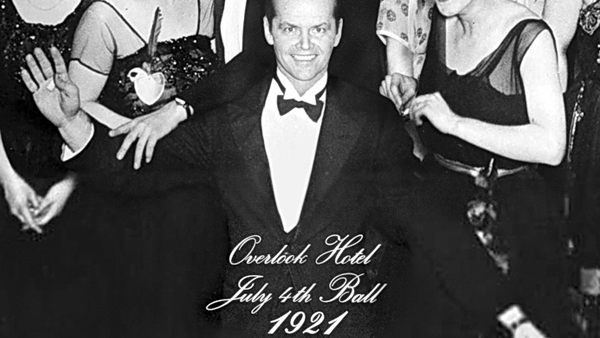
Whatever sin he committed during that era, it seems he’s destined to return decades later to try to kill his family, but only ends up killing himself by freezing to death while lost in a maze. And that’s the brilliance of The Shining – the Overlook Hotel is hell on earth and all the sinners who pass through the hotel doors must relive their sins forever.
REDRUM
The brilliant thing about “The Shining” is that it’s a movie where the horror comes from the most taboo subject, and that is harming one’s own family. The fear that the people who are the closest to you can harm you is why “The Shining” attacks the viewer at a psychological level.

Young Danny keeps repeating this word trying to warn his mother about the impending danger. It’s only later in the film when Wendy sees the reflection of the word written on a wall that she realizes “REDRUM” is “MURDER” spelled backwards.
Sense of Inevitability
“You know that something is building up in this place. It’s holding back this extraordinary dramatic punch that’s going to happen. You know it’s going to come somehow, at some time…”
– Martin Scorsese on The Shining
The film breaks one of the genre’s (one of Hollywood’s, really) key rules in the way that it refuses to play by the rules of psychological realism. We are in the realm of Freud’s The Uncanny and Bettelheim’s Uses of Enchantment, two texts Kubrick and collaborator Diane Johnson consulted while writing the script.
The film’s use of Dramatic Irony, or, the sort of irony where the audience knows something that the characters don’t, is exemplary, and this variety of the ironic has been used to savage effect for thousands of years, from the climax of Oedipus Rex to; Macbeth and on and on. It is a way of unifying the story and the audience, and “creating horror through inevitability”.
As we are led around the hotel at a brisk pace, learning it’s layout, the film abruptly switches gears and goes into a long section where we withdraw and observe the family going about their daily lives in the hotel. Nothing happens, per se, but, as mentioned before, Jack does begin to distance himself from the family, quietly losing his grip, and all while the Steadicam seems to glide around, having a mind of its own, almost like the consciousness of the hotel.
“The longer it takes for tension to be built, the more effective that tension becomes.”
And by this law, The Shining is one of the most suspenseful films ever.
We, in the audience, know that the protagonists are going to be cut off from the outside world, and that Jack is going to go insane, but, because the film follows the logic more of a dream than real life, the characters do not respond to this information in the way they would in a psychologically realistic work.
Kubrick is considered a genius director as far as versatility and vision. He is able to express feelings of isolation, enormity, and claustrophobia all in one in this film. The imagery is disturbing and perfectly timed for the audience’s psychological stress set off by a score that creates further tension.
Evolution of its Reception
When The Shining was released, the movie was nominated for two Razzies (the anti-Oscar awards that recognise the year’s worst films) – including ‘Worst Director’. And now, it is regarded as the most artful horror movie ever made. This contrast explains it all, how perceptions of The Shining have changed radically over time.
“More boring — and on a couple of occasions downright embarrassing — than anything else.”
– Popular film reviewer Gene Siskel’s verdict on The Shining in 1980. His colleague Roger Ebert didn’t even feature it on their television show, Sneak Previews, considering it unworthy of a mention. Critics and viewers alike complained about the lack of explicit shocks and the ponderous nature of the film’s pace.
“The crazier Nicholson gets, the more idiotic he looks. Shelley Duvall transforms the warm sympathetic wife of the book into a simpering, semi-retarded hysteric.”
– A 1980 Variety review
Rolling Stone’s Tim Cahill noted there was a critical re-evalutation of the film in process, as early as the mid 80s – noting that “critics seem to like [Kubrick] better in retrospect”.
In the 1987 interview, Kubrick elaborated on this himself:
“The first reviews of 2001 were insulting, let alone bad. An important Los Angeles critic faulted Paths of Glory because the actors didn’t speak with French accents. When Dr. Strangelove came out, a New York paper ran a review under the head ‘Moscow could not buy more harm to America’. But critical opinion on my films has always been salvaged by what I would call subsequent critical opinion.”
As predicted, The Shining also benefited from this. The late Roger Ebert, who had once thought the film not worth a slot on his show, awarded the movie a glowing write-up following a 2006 rewatch.
With age came an appreciation for Kubrick’s meticulous directing, and the atmosphere he created. Almost four decades later, The Shining is among the most recognizable films in cinema. A recent poll named The Shining as Britain’s favourite horror film. A quarter of voters declared Jack Torrance as the scariest character in the genre.
“It’s somehow risen from the ashes of its own bad press to redefine itself.”
The Book vs The Film

When Stephen King received a call from the great Stanley Kubrick in the middle of the night, informing him that he was interested in his novel, King was understandably enthused. However, this enthusiasm waned once he saw the final film.
Over the years, he became one of the vocal and scathing critic of Kubrick’s adaptation.
“I think ‘The Shining’ is a beautiful film and it looks terrific and as I’ve said before, it’s like a big, beautiful Cadillac with no engine inside it. In that sense, when it opened, a lot of the reviews weren’t very favorable and I was one of those reviewers. I kept my mouth shut at the time, but I didn’t care for it much.
“I feel the same because the character of Jack Torrance has no arc in that movie. Absolutely no arc at all. When we first see Jack Nicholson, he’s in the office of Mr. Ullman, the manager of the hotel, and you know, then, he’s crazy as a shit house rat. All he does is get crazier. In the book, he’s a guy who’s struggling with his sanity and finally loses it. To me, that’s a tragedy. In the movie, there’s no tragedy because there’s no real change. And it’s so misogynistic. I mean, Wendy Torrance is just presented as this sort of screaming dishrag. The other real difference is at the end of my book the hotel blows up, and at the end of Kubrick’s movie the hotel freezes. That’s the difference – warmth against cold.”
Kubrick’s films, with the exception of his first, Fear and Desire (which he himself disowned) all came from novels. Even Spartacus, the Dune in Kubrick’s filmography, was adapted by Dalton Trumbo from the novel by Howard Fast. His habit was to gather material around him and read through novels, tossing them aside if they not catch his interest. One in particular that did spark his imagination was Stephen King’s The Shining. Kubrick secured access to the rights, which Warner Bros. had already acquired, along with an adaptation by King himself.
“I found it very compulsive reading and I thought the plot ideas and structure were much more imaginative than anything I’ve ever read in the genre.”
– Stanley Kubrick, on Stephen King’s novel. He was, however, uninterested in King’s version of the script, preferring to start fresh.
By using a novel, he not only got to see a story fresh, but he was able to take the basic narrative building blocks and break them down into images. He literally translated the words on paper into the language of cinema to solve the problems of story that cinema presents, which is another reason why he did not generally adapt psychologically interior novels, or, if he did, he stripped them down so that the ideas could be communicated through image in a way that would translate to the screen.
Kubrick kept many elements from King’s novel, but discarded others, and many of the most famous parts of the movie are not in the book, and vice versa. The novel featured topiary monsters that came to life, as well as a sinister hose that did the same, and focused greatly on the archives of the hotel, which Jack discovers in the basement and contribute greatly to his insanity.
“In fantasy, you want things to have the appearance of being as realistic as possible. People should behave in the mundane way they normally do. You have to be especially careful about this in the scenes which deal with the bizarre or fantastic details of the story.”
– Stanley Kubrick
Celebrity Fanbase
It helps that the film has celebrity fans who continue to champion it. Martin Scorsese named it as one of his scariest movies of all time, Pixar Oscar winner Lee Unkrich runs a brilliant fansite dedicated to it, and Steven Spielberg counts his viewings in double figures. He even gave The Shining a loving tribute in Ready Player One, taking us on a dazzling virtual reality tour of the Overlook that brought Kubrick’s masterpiece to a new generation.
“I have seen The Shining 25 times, it’s one of my favourite pictures. Kubrick films tend to grow on you, you have to see them more than once. I defy you to name one Kubrick film that you can turn off once you start it… it’s impossible.
– Stephen Spielberg on The Shining
Forever and Ever and Ever
The thing about this film is that it really is a gift that keeps on giving, rewarding viewings with new insights, but never giving up all its secrets. To paraphrase Abraham Lincoln, you can’t scare all of the people, all of the time. But, you can scare some of the people, and The Shining does its best.
But the director, who was constantly rewriting the script, even throughout the shooting, was adamant that, “A story of the supernatural cannot be taken apart and analysed too closely. The ultimate test of its rationale is whether it is good enough to raise the hairs on the back of your neck. If you submit it to a completely logical and detailed analysis it will eventually appear absurd.”
Perhaps, then, the most incredible thing is that, almost 40 years later, innumerable people have submitted the film to logical and detailed analyses (including me in this post), and yet, the film still holds its power over audiences. Kubrick’s film, to paraphrase the Grady twins, invites to us all to come play in the Overlook Hotel forever and ever and ever…

 The Film Reel