

April 1917, the Western Front. A young soldier, Lance-Corporal Blake, is given a perilous mission. He has to carry a message through a “No Man’s Land” to a battalion of the Devonshires, revoking an attack planned for the next day.
The Germans have put just retreated to the Hindenburg Line – but aerial reconnaissance has revealed that their withdrawal is a trap. If the advance goes ahead 1,600 men may die with Blake’s brother among them. Cruelly, his commander, General Erinmore, has chosen him for this task precisely because he has that desperate incentive.
As instructed, Blake takes with him just one other soldier, Lance-Corporal Schofield. Our two young soldiers head off across fields of twisted barbed wire and rotting dead bodies, across animal carcasses and craters filled with rats, skulls and puddles of mud. Soon after making their way into the German trenches, they discover the former front line has indeed been abandoned – but the dangers they face are just the beginning. And all they have pushing them forward in this almost impossible mission is their resolve to carry the command out.
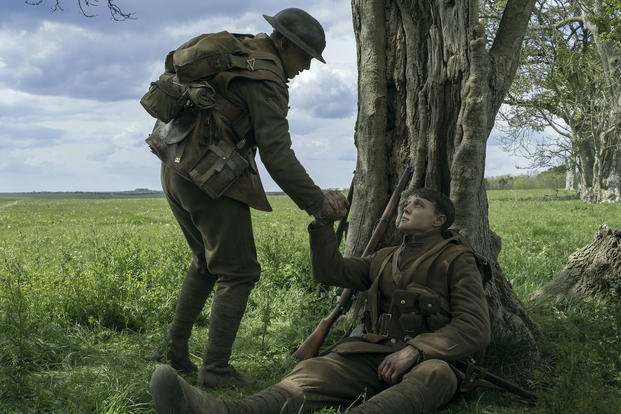
To take us all into their journey as immersed as possible, every scene is filmed from a single viewpoint, seemingly just one camera following Blake and Schofield closely all the time like an invisible third party to the trip – sometimes retreating before them as they rush through a trench, sometimes following them from behind, sometimes keeping up alongside – but never forgetting to look around to show us what they see.
To make his genius vision come to life, Sam Mendes has been assisted by the best in the business, from production designer Dennis Gassner and his yards of trenches and costume designer Jacqueline Durran’s functional and work-worn uniforms to composer Thomas Newman, turning in one of his best work. And then comes cinematography. The very best in today’s time and a true legend – a man that teaches me so much about never stopping to refine one’s craft and who never ceases to amaze me – Roger Deakins.

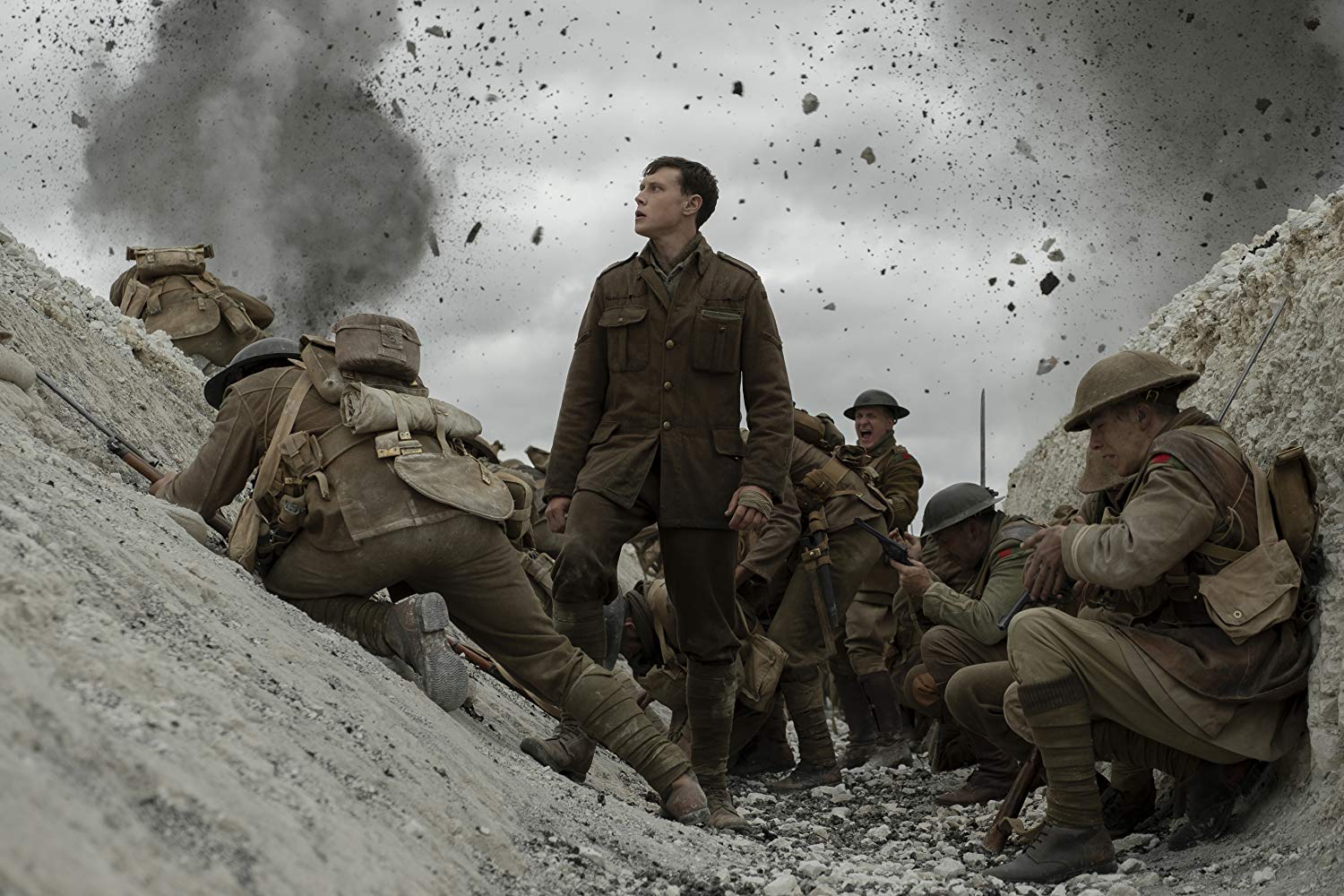
As Blake and Schofield set out the trenches, the camera moves swiftly backward with them as they race towards us. In that moment, we can feel their frantic pace and the claustrophobia of being on the narrow path.
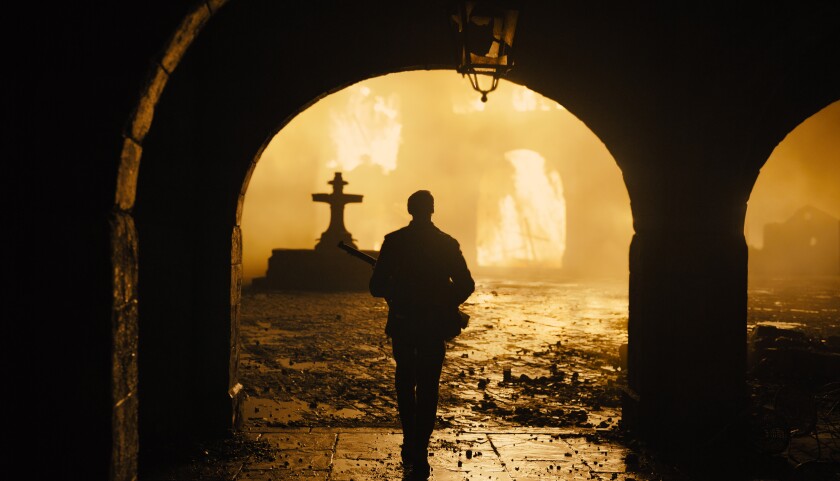
The light is a drama in itself, enhancing the feel of every scene, changing from the deep shadows in the room where Blake and Schofield get their orders, to deceptively bright skies, and eventually a huge plume of fire glowing orange against a pitch-black night sky.
One of my favourite moments apart from the entire night scene was when Blake and Schofield painfully fought their way through the barbed wires barricades and the camera keeps up with them unobstructed and you wonder how.
For me, the major takeaway was the cinematography. Speaking of it, let’s clarify one thing: 1917 is not a single-take film. It may look like it was made in one take, because Mendes, Deakins and editor Lee Smith designed it that way, but of course it’s probably like 30 to 40 long shots. Some of them last eight or nine minutes. But what really sets it apart is how marvelous those shots were and how seamless those cuts were. Editing is usually a post-production work. But 1917 is one of those films where the editor had to be very much present during the shooting, taking the creative decisions with Mendes and Deakins.
“Figuring out the right balance of the shot. Are you behind them all the time? How often do you have to be on their faces? Is it too claustrophobic to pull them all the way down a trench? Once we settled on the feel of the camera, then it was just a technical challenge to figure out how to break our one shot down into sections so it was manageable.”
Roger Deakins on how much of a challenge was 1917

Even though 1917 is so beholden to its narrative framework, Mendes has also assembled a range of actors who add emotional depth to a demanding idea. The depth of the connection between the story and the audience should also be credited to the natural acting of the two leads. Chapman, likely best known as the young King Tommen from Game of Thrones, serves as the film’s heart as Blake, eager to push through a seemingly possible mission in the hopes of saving one of the few good things left in his life (his beloved brother, by a fellow Thrones star Richard Madden).
In the early stretches of the journey, before the action and danger intensify, Blake talks about home. There is a certain goodness of the character, too young to be in such danger. The image of this baby-faced soldier running towards the camera perfectly captures what was so heartbreaking about World War I – all those innocence sent into battle, all those futures destroyed.

Schofield, played by George MacKay, is quieter and has to be drawn out, reluctantly admitting that he won a medal for fighting at the Somme – a medal he does not value and no longer owns. Despite his disillusionment, he remains committed to the mission and protective of Blake. This is the character that has the greater trajectory in the film, and McKay comes through with an astonishing performance.
As the film moved on from one shocking set to another, the narrative too was studded with starry cameos – Andrew Scott as a cynical Lieutenant, Mark Strong as a stern but sympathetic Captain, Benedict Cumberbatch as an angry, ambitious Colonel and Colin Firth as the General who gives them this mission in the first place. These characters round out a look at how very different each soldier is, how wildly apart their aims and desires can be even in the midst of a exhilarating event like the “Great War”.
Thomas Newman’s dramatic score was exactly what the plot demanded, reflecting the various themes of the film. There was one song scoring the woodland scene, that stood out in particular for me. Though many critics were of the opinion that this song slowed down the pace of the film before the end, for me it was just the opposite. I felt the need of the song right at that point in the film. Schofield, after being chased by German soldiers in the night, escapes by jumping into a river (another great shot) and gets swept away into a waterfall before reaching the riverbank by morning. As he walks towards the woods, we can hear someone singing in the distance. Slowly it grows louder. Taking a seat among the trees beside a crowd of his fellow troops in a memorable woodland scene, Schofield takes a moment to rest and watch a single soldier perform this stunning song, which echoes his longing for home. And so do we. After witnessing blood, bombs, death and battling through strong river currents, this sombre and earnest music provided Schofield – and us – with a sense of reflection.
At its core, the song “Wayfaring Stranger” is the story of a lost soul on a journey through life, which makes it perfect for the scene. Although the exact origins of the song are unknown, many people believe it finds its roots in American folk and gospel music. It has been covered by several artists including Burl Ives, Emmylou Harris and Johnny Cash. In the film, the song is beautifully performed by actor and singer Jos Slovick.

Mendes dedicated the film to his grandfather, Alfred Mendes, who fought in the war, and he has incorporated his anecdotes. This riveting film lets the viewers taste and feel the horrors of war in all its brutality. He also has plenty to say about war and how it corrupts from within, and the uselessness of medals used to reward soldiers in battle.
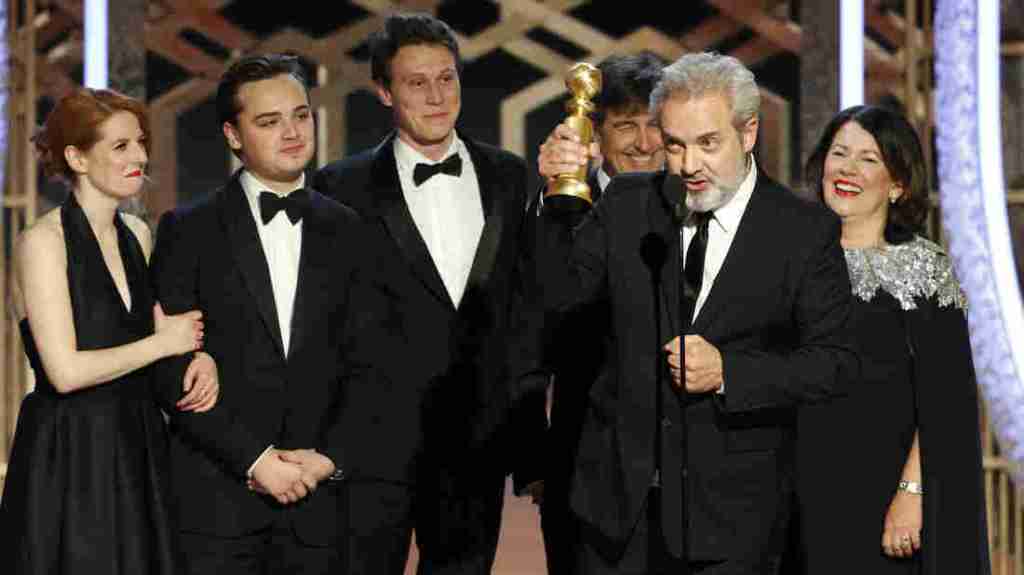
1917 bagged almost every BAFTA this year, including Best Picture, Outstanding British Film of the Year, Best Director, Best Cinematography, Best Production Design. It won the Best Motion Picture – Drama and Best Director at the Golden Globes. At the Oscars, though it came a close second for Best Picture, it dominated the Oscar craft Awards – Best Cinematography, Best Sound Mixing and Best Visual Effects.
In 1917, Sam Mendes doesn’t have a particularly new tale to tell — it’s essentially an impossible-mission world war drama, like Dunkirk, Saving Private Ryan, and countless films before it — but it’s all about the new, creative and remarkable way of telling it. In a time when films are served and handed to us in our smartphones by numerous OTT platforms, 1917 is one such work of outstanding artistry and skill and a visual masterpiece that proves yet again that cinema will always be worth watching on the big screen.

 The Film Reel