
                                                                         CAPTAIN
                                                 Psst! Computer.
                                                               (the holo-screen lights up)
                                                 Define "dancing".
          BACK OUTSIDE THE AXIOM
          Eve and Wall-E descend along the starboard side.
          Spiral gracefully around one another.
                                                                          SHIP'S COMPUTER (V.O.)
                                                 "Dancing" - A series of movements,
                                                  involving two partners, where speed and
                                                  rhythm match harmoniously with music.
          Wall-E's extinguisher runs out of foam.
          He lets it float freely out into space.
          Eve catches him in her arms.
          Wall-E croons.

I remember when I first saw Wall-E and EVE waltzing through outer space in this iconic scene and felt this film carving a special place in my heart. Twelve years later, the feeling has not changed a bit. This scene signified the highest point in the film and was such a perfect example of everything that Disney-Pixar’s 2006 animation feature WALL-E did right that it flawlessly exemplifies why it’s one of the best and the most ambitious animation films, all on its own.
WALL-E and EVE
The film opens with the song “Put On Your Sunday Clothes” from Hello, Dolly playing over pictures of outer space. The song echoes a world of optimism (“Put on your Sunday clothes, there’s lots of world out there”). But as the camera moves in on Earth and focuses in on a major city, we see utter devastation and massive piles of geometrically arranged trash.

It’s 2700, and human civilization has perished on Earth. The only animate object left in the lifeless, dusty landscape of desolation that we used to call our home is one tireless mechanical waste-collector called Wall-E (Waste Allocation Load Lifter – Earth Class). He lives in a cluttered container and spends his days buzzing about, piling up junk to look like skyscrapers and sucking up the sun for his solar panels, just as he has done for hundreds of years. His only company is a lonesome cockroach.
The loneliness of his existence breaks our heart in the first five minutes, and the best part is that will have this effect on and will be understood by viewers across age groups and various cultures because he doesn’t communicate with words.
Wall-E is alluring, and not because he’s got big eyes or dangling eyelashes but because he’s smart, hard-working, with a romantic side, and is hopelessly addicted to watching clips of Michael Crawford and Barbra Streisand in Gene Kelly’s Hello Dolly! on a video screen. He’s everything we should have been if we hadn’t put all our energy into destroying the planet. But none of this has been made preachy or obvious.
The monotone of Wall-E’s routine breaks when he discovers a new purpose in life after he meets a sleek search robot named EVE (Extraterrestrial Vegetation Evaluator). Introduced as unemotional, powerful and furious, EVE is the very antithesis of WALL-E. She is professional, responsible and a clear outlier among the robots. Deeply in love with EVE, Wall-E tries to win her affections. He shares all the things he loves with EVE with utmost joy. He even protects EVE and watches after her once she shuts down.

The plot unravels when EVE comes to realize that Wall-E has inadvertently stumbled upon the key to the planet’s future, and races back to space to report to the humans. Meanwhile, Wall-E chases EVE across the galaxy and sets into motion one of the most imaginative adventures ever brought to the big screen.
The last scene of the film sees the frantic revival of Wall-E by EVE, and the loss of Wall-E’s memory after being brought back to ‘life’. After multiple failed attempts to make him recognize her, EVE decides to bid farewell to him by humming a tune and kissing him (literally an electric shock).
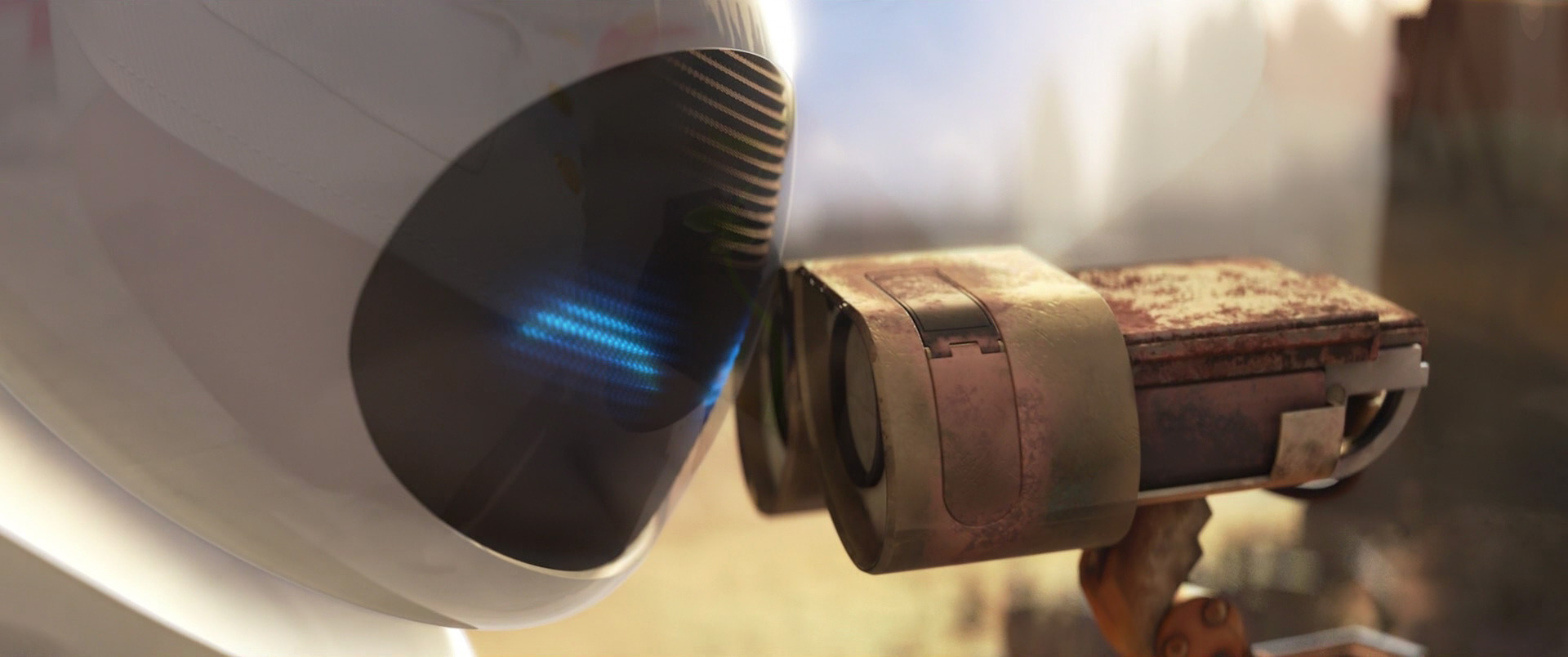
In a quintessentially Disney moment, Wall-E affectionately utters EVE’s name after what seemed to be a brief period of rebooting. Michael Crawford’s “It Only Takes A Moment” playing in the background provides the perfect ending to Disney-Pixar’s most unconventional love story that taught us the difference between the ordinary and the extraordinary — a little bit of hope, and a little bit of love.
Wall-E and EVE have become one of the most iconic couples in animation history. Their love bears testament to the age-old saying — opposites attract. Yes, they do, and in the most beautiful ways.
Lack of Dialogue
One of the most iconic aspects about WALL-E is the fact that more than half of the film is done without dialogue. The film just wouldn’t be the same if the loveable robot could speak or if Wall-E and EVE had a romantic conversation as they watched the sunset.
Any story could be told in a million ways. And especially if it is told through animation, there are literally no rules – you can have toys coming to life, bugs rebelling against grasshoppers, two sisters discovering the most adorable spirit as their neighbor, fish getting estranged from his family – but each of those unique stories could be told in so many different ways.
In WALL-E we follow a robot on this massive adventure as he leaves the garbage-ridden Earth – his home, flies through space and eventually makes it on-board a spaceship, but we see it all without dialogue and we barely even notice. There is so much that can be said with a simple glance, a gesture, a minimal sound effect or even a brief cut that 12 pages of dialogue can never achieve. WALL-E proves this, and how!
For the first 40 minutes, we watch in wonder as Wall-E goes about his business in near silence. What is most amazing is the sharp intelligence of the detail, which is rendered so painstakingly.

Music
Thomas Newman (Finding Nemo, Finding Dory) did an astounding job at composing and conducting the original score, filling the movie with wonder and beauty. In a movie with very little dialogue, especially between the two main protagonists, the music needs to be expressive and descriptive – it needs to envelop the viewer in the story and help them connect and empathize with the characters. Newman’s score does exactly this. To add to that, the way the soundtrack seamlessly mingles with 60’s Broadway music, Louis Armstrong’s cover of “La Vie En Rose” (1950) and to the songs from Hello, Dolly! – is pure genius.
Classic film and music references

Speaking of it, one of the reasons this film is so special is because of all the beautiful references to this iconic musical. Lets talk about that opening sequence and the use of Put on Your Sunday Clothes:
“Out there
There’s a world outside of Yonkers
Way out there beyond this hick town, Barnaby
There’s a slick town, Barnaby
Out there
Full of shine and full of sparkle
Close your eyes and see it glisten, Barnaby
Listen, Barnaby”
The lyrics are dripping with nostalgia and fit WALL-E’s story almost perfectly – the urge to make our home planet the way it once was, before it was overflowing with garbage and waste, and to set off into space, exploring the world outside of Earth. Those lyrics also capture the whimsically and childlike wonder of Wall-E.
Though this focus on Hello, Dolly! was deemed “random” by some critics, I think it makes proper sense. Wall-E only has the VHS copy of the musical to keep him company on Earth. Just like his cockroach friend, Hello, Dolly! is one of his companions and part of him; it’s what keeps him going and motivated throughout the film.
Sound effects
Even when Wall-E and EVE can’t exactly speak, why is it so easy to understand what they are saying? A combination of a clever animation of gestures, and the creation of futuristic yet familiar sound effects. Ben Burtt, who is famously known for creating the ‘voice’ of R2-D2 in Star Wars (along with many other iconic Star Wars sound effects), was the sound designer for WALL-E and could even be credited as the ‘voice’ of Wall-E himself. The sound effects of this film, along with the score flesh out the oddly beautiful post-apocalyptic world that we’re introduced to. The whistles, tones, and clicks are more than enough to give the characters the emotions that they need to express. It’s so clever, and again, so ambitious.
Character Designs
One of the most charming elements about WALL·E is all the character designs – they’re simple yet efficient. There’s just enough detail to not distract us from the heart of the story. The design of AUTO is also simplistic, and yet we’re terrified of him and want him to be shut down completely. From the dirty, clunky box shapes of WALL·E, and the sleek and oval designs of Eve, to even the round and disproportioned humans; the way each character was crafted tells us perfectly about who they are and how they interact with others in the world around them.
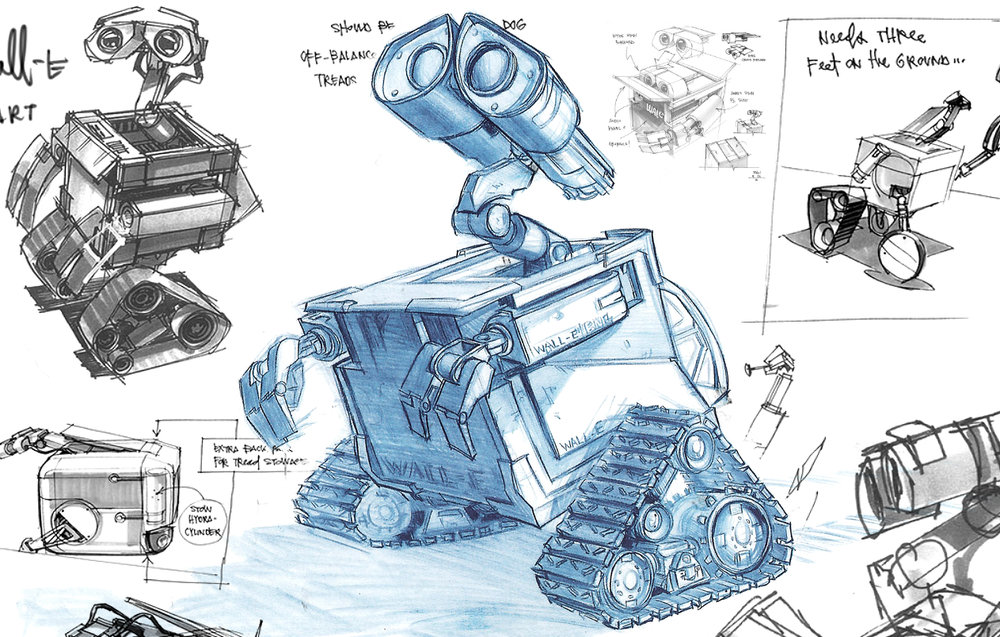
Indeed, he’s partly inspired by that loveable droid R2-D2 from Star Wars; his noises were created by the same sound designer, Ben Burtt.
Andrew Stanton

WALL-E and Finding Nemo are two of my most favorite animation films – the major reason being the Andrew Stanton’s vision behind them.
Each director has their own vision, they bring a part of themselves on to their projects. If Brad Bird or Pete Docter directed this film, it would’ve been a brilliant film but it would’ve been different. Wall-E would have been there, maybe the same story would have remained intact, but the vision would have been something else entirely. WALL-E works so well because it’s Andrew Stanton’s vision (A Bug’s Life, Finding Nemo, Finding Dory).
You look at WALL-E and it fits so well with the other stories on his fantastic repertoire. His films are always so simplistic, ambitious, and character-driven. Stanton pushes his characters out of their comfort zones, putting them into these massive environments and seeing how they’re going to react: Flick leaving the comforts of the colony in A Bug’s Life, Marlin facing his fears and literally swimming out into the deep blue sea in Finding Nemo, and even Wall-E flying into space to follow the love of his life; there’s a common theme of exploration, both internally and externally, with Stanton’s films.
Relevant – Now more than ever
Apart from the brilliance of the animation, the innocent charm of the comedy, the artfulness of the story-telling, we know we’re watching something made with absolute integrity. That’s the Pixar hallmark. This first child of the marriage of Disney and Pixar is an epitome of this and deserves a place as the greatest animations ever made. Wall-E himself teaches us to be kind and loyal, and the film’s overarching environmental and commercial themes make it forever, and increasingly, relevant.
The film’s fictional mega-corp Buy-N-Large is a take on unchecked capitalism and a corporate takeover of the planet. It is an embodiment of modern consumerism at the expense of natural human ways.

Humans in the movie are bed-bound, glued to a screen and unable to do anything without the aid of a robot, whilst WALL-E himself longs for a physical connection. In this pandemic, being without the ones we love for such an extended period of time has been extremely difficult. Though technology has helped us stay connected, mental health has been a huge factor for many – especially those who have struggled to find any motivation to get out of bed. Dealing with the elements of separation and dependence, it is this growing reliance on technology for basic needs that WALL-E warns of.
Re-watching this film in the age of Covid-19 brings some harrowing truths to the surface. During the first months of lockdown, our streets were clean, beaches were litter-free for the first time and pollution levels were at an all-time low. We saw news headlining “Nature will rightfully reclaim its place through extreme measures.” People were realizing their appreciation for nature. But relaxation in the rules has brought back a careless attitude to our surroundings. Within hours, the pavements were overcrowded and the same beaches were left in a disgusting state. If we don’t bother to be responsible in our stewardship of our own planet, this just might become a reality – sooner than we expect.
WALL-E wasn’t afraid to put this environmental message right at its core. It never lectures us – the lesson was interwoven into a unique, universal love story.

Throughout the film, the plant — the only one found on Earth — becomes a metaphor for hope and a glimpse of a possibility that the world is indeed more malleable and habitable when handled with care. Wall-E and EVE made us realize that true love prevails and humanity can work together no matter what; that we can avoid this dystopian trajectory of human civilization if we can respect the sanctity of Mother Nature. WALL-E shows us that light at the end of a dark tunnel; it gives us hope for a better tomorrow.

 The Film Reel