There are two films in the Harry Potter franchise that I have a bi-polar appreciation for. Previously, I have said why I think Prisoner of Azkaban is the best one of the lot, because of the brilliant direction of Alfonso Cuaron, even though I don’t like that some of the important plot points from the book didn’t get a place in the film. Today, I want to talk about my least favourite film of the franchise, the sixth film in the series Harry Potter and the Half-Blood Prince. Be it the ridiculous character development of Ginny Weasley, her relationship with Harry which the films have proudly minimized to be mere awkwardness, or the abrupt anticlimactic end, there are a number of criticisms I have with it – almost all of them relating to differences between the original novel and the film adaptation. But where this film has polarized me is in its ingenious cinematography by Bruno Delbonnel, which is arguably the best ever in the entire series.

Out of all the films in the series, Harry Potter and the Half-Blood Prince is the only one that was nominated for an Oscar for Best Cinematography. Also known for his work on Amelie and Coen Brothers’ Inside Llewyn Davis, Bruno Delbonnel may arguably be the most well-recognized cinematographer the Harry Potter series ever had. The exploration of darker motifs, character development, and strikingly alluring cinematography are some of its most accomplished features found in this film.
Delbonnel uses both light and colour of these areas of focus to control the film’s mood. Throughout the film, there is less and less lighting. This effects the colour grading of the film as well. The tone is very muted, creating a more eerie feel for the once cheerful. The entire film is draped in hues of black, gray, beige, brown, and pops of green and red, designing a more serious and whimsical mood and setting.
A Fading Memory
Up until Alfonso Cuaron helmed Harry Potter and the Prisoner Azkaban, the Harry Potter films were approached as children’s films, and that was the focus. After Alfonso, the films began to grow in maturity as Harry grew older, and so did the target audience. The look of the films evolved as part of the process.
Every scene you see of Hogwarts in The Half-Blood Prince is a fading memory. Where the first two films were filmed without any depth because there was barely any worry, the last few films are now capturing the beauty of the magic in Harry’s world as it slowly fades away. Bruno shoots Hogwarts like it’s a candle; it’s flame is burning out, and the kids are taking one last moment to look back at it. Delbonnel visualizes Hogwarts like a candle, its flame slowly burning out and we, along with the students are trying to take one last moment to look back at it.
Delbonnel always wanted to challenge himself on the set and it was very evident as every single scene in Harry Potter and the Half-Blood Prince looks like it had effort put into it, whether it was a serious moment in the film, or whether it was Lavender Brown obsessively breath-fogging a heart into a window for Ron as Harry awkwardly sat watching. Because of the Half-Blood Prince being the penultimate entry in the series, director David Yates wanted this film to be in a way to let us revisit Hogwarts as a normal teenager one last time. It served as a calm before the storm that was to come with the final Deathly Hallows films. Keeping this in mind, Bruno approached the film’s look with an ominous backdrop. Every light-hearted scene was done with bleak colors, a dreamlike glow, and an overall style that subtly lets us know that all of this was only temporary. It was the film’s way of showing that everyone was trying to make the most of what they could with the time that they have – before it all ends inevitably.
Here are some of my favourite shots from Half-Blood Prince compared to Philosopher’s Stone or Chamber of Secrets that define how darkness has evolved in the stories as Harry grew up:
hogwarts express:


the great hall:


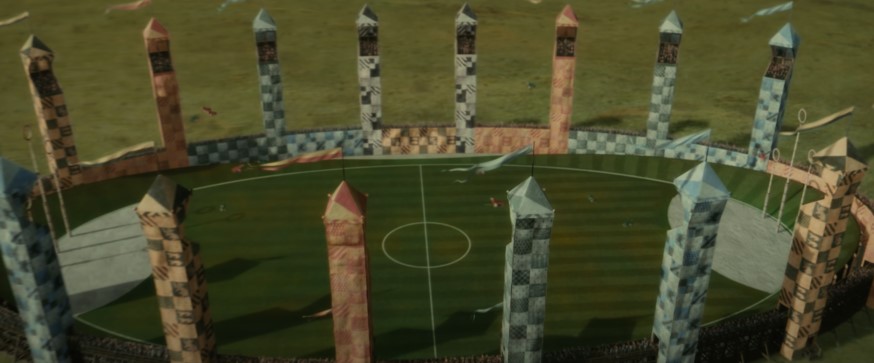
quidditch ground:

“Some of the sets are there since the very first Potter. How could I light them in a different way? This question brought another one based on the series itself. It was Potter number six, the story was less about the big fights than the relationships between the characters. Nevertheless the drama is still there and I thought it would be interesting to have those very intimate stories amidst this very dark mood. As if the school was a dark character. That’s when I suggested to go for this dark moody variations of grays.”
– Bruno Delbonnel, when asked about the challenges he faced.
The Art of Symmetry
Symmetry is a big motif in Half-Blood Prince and it is evident in almost every shots. Symmetrical shots not only look stylistic, but also are used to draw the audience’s focus on a particular character or object. These are few of the many examples of how Delbonnel uses colors, lighting, and symmetry to construct the serious and afflicted tone of the film and its characters


A “Pensieve” Mood

Throughout the film, Delnonnel uses a brown-black platina effect, but the most striking use of colour is in the Pensieve scenes. A faded vignette and a standout greenish blue colour grading, along with an echo of distorted sound – this is how Delbonnnel made these scenes feel like physical manifestation of memories.

Draco – The Other Chosen One

As with the shots of Draco (who goes through a huge arc in this film), Delbonnel chose to fill his scenes with dark colors and sparse use of light to further suggest his secrecy and grim events that are to pass. In which, it is appropriate since Draco, and his journey is the essence of the film. The Half-Blood Prince is very much about facing dangerous truths that will change the course of the characters’ lives forever and dealing with the realities of what is to come from it. Draco is not a killer but is expected to be one. Failure to do so risks the lives of his family and his own. With Tom Felton’s captivating performance, Nicholas Hooper’s melancholic score and Delbonnel’s style, we feel the weight on Draco’s shoulders trying to shuffle his adolescent life at Hogwarts and acting out the murderous deed set before him by Voldemort. Rowling’s message that as snobby as a person can behave, that doesn’t necessarily make them evil – is made real.
For instance, the scene where Draco is shown in the far background walking down a Hogwarts hallway alone. He is heading to kill Dumbledore, while a group of his peers make out and eat popcorn in the foreground—perfectly depicting his struggle. From here, we get most shots of him isolated throughout the hallways and rooms of Hogwarts or acting aloof when he has to be around other people. So, in one skillfully lit hallway scene of Draco heading to the vanishing cabinet, we get a vivid shot of the mood and setting captured. It suggests motifs of isolation, secrets, alliances, and unpleasant things to come. The only illumination in this scene is coming from a backlight cast at the end of the hall that Draco is walking through.

Once reaching the end, he pauses as if contemplating the burden of his task and how he must handle it. Draco’s hesitation is reminiscent of the other characters in Half-Blood Prince. As they, too, are continually forced to answer to the call of other people and act in a way that will keep them safe, and the people they love despite tremendous odds. Snape has to answer to the Dark Lord’s many orders and requirements of the Unbreakable Vow with Narcissa Malfoy. Harry must do as Dumbledore instructs to uncover a vital memory. Slughorn is forced to face an unpleasant, shameful recollection, and Dumbledore understands the sacrifices he must make to discover the Dark Lord’s secret.
Harry Confronts Draco
When Harry fights Draco, we not only get two rivals, finally squaring off, but we get to see the vulnerability and the complexity of both characters in a short time. Draco is seen sobbing alone as he looks at himself in the mirror, realizing he is failing and that he may indeed die. Draco is a character that does not inspire much compassion for most of the series. However, in The Half-Blood Prince he is given a new perspective. Alternatively, with Harry, his actions prompt disappointment for his reckless use of the Sectumsempra spell, something which Harry himself noticeably feels once he sees Draco helplessly bleeding on the bathroom floor.

The first, and most noticeable aspect being how this part over any other in the film is in black and white with a whimsical effect. The aesthetic decision to make the scene monochrome – except for Draco’s blood – gave it a noir look and heightened the beauty amidst the suffering. The black and white scene also serves to provoke the dramatic development between Draco and Harry, which results in a show of vulnerability, violence, and regret. On the other hand, the blocking for this scene involved Draco and Harry playing off one another as they moved through the bathroom, either seeking shelter or finding the other to attack.
For example, the blocking positions the actors where the mirror is, revealing both characters blurred within the frame. Accordingly, it captures them moving throughout their battle under the stalls and through the long walk-way, ending with Harry casting the Sectumsempra spell wounding Draco. Additional to a picturesque long shot of Draco reflecting his destiny, a few close-ups, low angle shots, and various medium shots capturing Draco and Harry’s thoughts, there is a superb overhead shot of Snape casting a healing spell to save Draco.


Overall, this scene is admirable because it decisively shows us the intricacy of Harry, Draco, and Snape. As well as characteristics of each that we did not know were there or rarely get to see. Harry almost killed Draco and felt genuine regret for hurting him; Draco is not entirely evil and does have a conscience; Snape is not as detached, as he looks at Harry with disbelief for him using his defense spell and knowing it.
The Cave
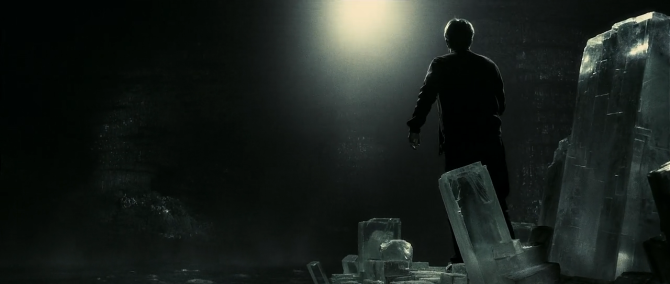
The scene where Harry and Dumbledore enter the cave was cited by the cinematographer as a particularly challenging task. In the book, the only light that illuminated the cave was static, remaining in one place at the bowl. What Bruno decided to do was have the light rise up in the air and circle around both characters, adding a more dynamic approach to an unsettling scene.


Light and Shadows
There is a very soft lighting that Delbonnel tries to achieve, without compromising the contrast to separate the subject and the background. In the below scenes, we see the subject and background separation is achieved by exposing the subject a few stops higher than the background.


However, in the case of outdoor scenes (below), Delbonnel does quite the opposite. Here, he achieves separation by exposing for the background, which becomes a few stops brighter than the subjects.


“I am the Half-Blood Prince”

We get this brilliant extreme long-shot of Harry and Snape fighting with a tone of intense grief and hatred. Seeing the now breached Hogwarts in the background with Harry and Snape in the middle ground battling it out is one of the most unforgettable shots within the Harry Potter universe and most importantly, is one that perfectly embodies its films that are to follow.

Rewatching this film recently after being previously upset with its screenplay and the character developments (read: butchering Ginny Weasley), I found myself saying something not too different than Harry’s last words in the film: I never actually realized how visually beautiful this film is, how much of a genius Bruno Delbonnel really is and what skillful and expressive cinematography can do at its finest.

 The Film Reel